
AI Deepfakes in Schools: What Leaders Must Do Now
AI deepfakes pose significant risk to students' emotional health, critical thinking skills, and overall safety, demanding immediate attention from school leaders.
EDUCATION
ParentEd AI Editorial Team
3/5/20265 min read
Informed by UNICEF/INTERPOL research, February 2026
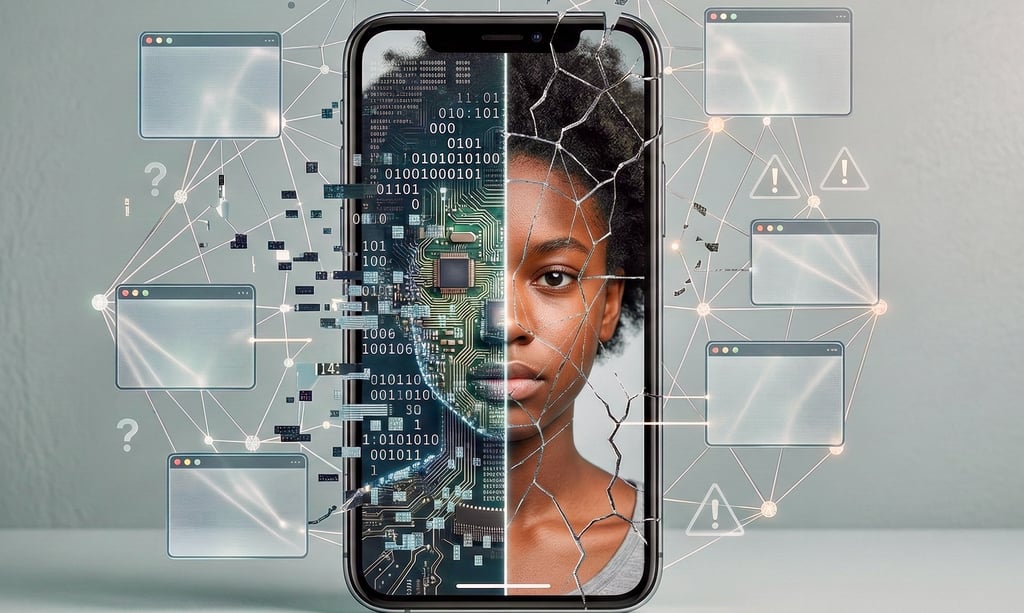
Imagine this: It's Monday morning. Before the first bell, a video is already circulating on Discord. It appears to show one of your students — but it was never filmed. It was generated by an AI tool, takes seconds to create, and has already been seen by a third of your school. By the time your vice principal hears about it, the damage is done.
This is no longer a hypothetical. According to a February 2026 study conducted by UNICEF, INTERPOL, and the ECPAT global network across 11 countries, at least 1.2 million young people disclosed having their images manipulated into explicit deepfakes in the past year alone. In the hardest-hit countries, that translates to roughly one child per classroom.
For school leaders, this data reframes what we thought we knew about online safety. AI-generated deepfakes and targeted misinformation are no longer emerging risks on the horizon — they are active threats inside your school community right now, affecting student mental health, peer relationships, staff reputations, and institutional trust.
Generic digital citizenship lessons are not enough. What follows is a practical roadmap built for school leaders who need to act — not just be aware.
Understanding the Threat: Three Ways It Shows Up in Your School
Before you can respond effectively, your leadership team needs a shared picture of what you're actually dealing with. Today's AI threats to students arrive in three distinct forms:
1. Weaponized Identity
Deepfake tools — including so-called "nudification" apps that strip clothing from photos — are being used to create fabricated explicit or defamatory images of students and staff. The UNICEF study found that in some countries, up to two-thirds of young people worry that AI could be used to create fake sexual images or videos of them. This is not a fringe fear. The velocity of sharing means a fabricated image can reach hundreds of peers before any adult is aware it exists.
2. Algorithmic Manipulation
AI-generated personas — chatbots, audio-cloned influencers, synthetic social media accounts — are spreading tailored misinformation that bypasses a child's natural skepticism precisely because it feels personal and familiar. Unlike broadcast "fake news," this content is designed to build a relationship with the target before delivering its message.
3. The Trust Collapse
When students cannot tell whether a video of a peer or a teacher is real, the foundational trust that makes a school community function begins to erode. Hyper-vigilance, social withdrawal, and anxiety are predictable consequences. This is not just a student wellness issue — it directly affects your school climate data and, ultimately, your capacity to teach.
The Leadership Roadmap: Four Actions You Can Start This Term
Action 1: Upgrade Your Curriculum to Media Forensic Literacy
Traditional digital safety education — "don't talk to strangers," "check for blurry edges" — is no longer sufficient. AI image generation has largely overcome the visual artifacts that older detection advice relied on. Your curriculum needs to teach a different skill: not how to spot a fake, but how to verify a claim.
The SIFT method (Stop, Investigate the source, Find better coverage, Trace claims to their original context) is a research-validated framework that gives students a transferable process for evaluating any piece of content. Critically, it doesn't require students to be technical experts.
Practical integration points:
History: Compare primary source documents to AI-generated synthetic versions; discuss how historians verify authenticity
Science: Examine how generative AI models work at a conceptual level — demystifying the technology reduces its power to deceive
Advisory / PSHE: Structured conversation about students' own experiences with AI content online, using SIFT as the analytical framework
Recommended resource: MediaWise for Schools and Common Sense Media's Digital Citizenship curriculum both offer classroom-ready SIFT-aligned materials.
Action 2: Build a Rapid Response Protocol — Before You Need It
Standard bullying procedures were designed for a slower-moving world. A deepfake incident can go viral in minutes; your response protocol must match that speed. Waiting for a major incident to occur before updating your handbook is not a neutral choice — it is a risk to your students and your institution.
Add an AI Incident Annex to your existing safeguarding or student conduct handbook. It should include:
Immediate triage steps: Screenshot and preserve the content; report to the relevant platform using their official reporting channel within 24 hours; notify the designated safeguarding lead
Victim support pathway: Assign a named counselor immediately. Students targeted by fabricated imagery experience a specific form of harm — their identity has been appropriated without consent. Standard bullying support scripts may not be adequate; counselors should be briefed in advance on this distinction
Legal clarity: Note that legal frameworks around AI-generated imagery vary significantly by jurisdiction and are still actively developing. Pre-establish contact with your local law enforcement and legal counsel so you are not making those calls in the middle of an incident
Tracking metric: Log AI-related incidents term-over-term. This baseline will help you measure whether your interventions are working and provides documentation if systemic advocacy becomes necessary
Action 3: Give Parents Tools, Not Just Warnings
Most parents currently sit between fear and a lack of technical fluency. They know something is wrong but don't know what to do about it. A newsletter raising awareness is useful; a toolkit that reduces their workload is transformative.
Consider a Home-School Safety Compact that provides:
Living links, not static instructions: Rather than printing platform privacy settings (which change frequently and will quickly become outdated), point parents directly to the safety centers of the platforms their children use most. Discord, Roblox, and TikTok each maintain dedicated parent/guardian safety pages that stay current
Conversation starters: Short, non-confrontational scripts help parents open dialogue without triggering defensiveness. Example: "I've been reading about some AI stuff that's affecting kids your age — have you or any of your friends come across anything like that?" The goal is curiosity, not interrogation
A reporting path: Make it explicit and easy: if a parent or child encounters a deepfake or manipulated image involving a student, here is exactly who to contact and how
Action 4: Add Your Voice to Platform Accountability Efforts
Individual schools cannot change the policies of major technology companies. But your district, in concert with others, can. UNICEF's February 2026 guidance specifically calls on digital platforms to move beyond reactive content removal toward active prevention — investing in detection technologies and strengthening content moderation before harm occurs.
For district leaders and board members:
Work with your Board of Education to draft formal written inquiries to platform providers asking what AI-detection safeguards they have in place for minors
Use your collective purchasing power as a consumer of educational technology to demand AI transparency from edtech vendors in your contracts
Connect with peer districts and professional associations — a coordinated voice carries more weight than individual letters
Note: This is a district- or board-level action. Building leaders may not have the remit to drive platform advocacy directly, but they can bring the data and the urgency to the people who do.
The Bottom Line
We understand that school leaders are being asked to absorb this alongside everything else — staffing pressures, curriculum demands, budget constraints, and the daily unpredictability of running a school. None of that goes away. But the data from UNICEF is unambiguous: this is happening to children now, in significant numbers, and the schools that will protect their students best are the ones that build their protocols before an incident forces their hand.
The four actions above are designed to be modular. You don't have to do everything at once. Start with the protocol update — it costs nothing and creates immediate clarity for your staff. Add the curriculum component next. Build the parent toolkit over a term. Engage on advocacy when capacity allows.
What matters most is that you move from awareness to action — and that your students know their school is paying attention.
Key Resources
UNICEF brief on AI and child sexual abuse and exploitation: unicef.org
UNICEF Policy Guidance on AI and Children 3.0: unicef.org/innocenti
Common Sense Media Digital Citizenship Curriculum