
AI in Our Classrooms: Why Parents (and Kids) Are Pulling the Emergency Brake
When ChatGPT burst onto the scene, it felt like the ultimate homework helper—a 24/7 tutor that could explain algebra in seconds. But a few years into this AI boom, the honeymoon phase is officially over. Parents aren't just getting anxious; they're pushing back.
PARENTING
ParentEd AI Academy Staff
5/22/20263 min read

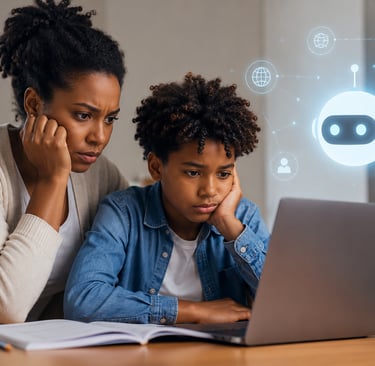
Between making dinner, tracking down missing soccer cleats, and managing screen time, you now have a new job title: AI Guardian.
When ChatGPT burst onto the scene, it felt like the ultimate homework helper—a 24/7 tutor that could explain algebra in seconds. But a few years into this AI boom, the honeymoon phase is officially over. Parents aren't just getting anxious; they're pushing back.
And surprisingly? So are the kids.
Here is a quick, no-nonsense breakdown of what is actually happening in schools right now, why families are sounding the alarm, and exactly how you can protect your child's critical thinking and privacy.
1. The "Easy Button" Dilemma (Learning vs. Copying)
The biggest worry around the dinner table isn't that kids will use AI—it’s that they’ll stop thinking for themselves.
Teachers and parents are noticing a shift: instead of wrestling with a tough essay prompt or math problem, some kids immediately outsource the brainwork to an AI chatbot. It’s not necessarily about cheating; it’s about a loss of persistence. If a screen gives you the answer instantly, why bother sitting with the frustration of learning?
The Plot Twist: Students are starting to worry about this, too. A widely discussed report by the Brookings Institution highlighted that many students fear relying too heavily on AI will actually weaken their own brains over time.
In fact, a high schooler’s post went viral on Reddit after they protested an assignment that forced them to use AI. The student’s argument? “I wanted to actually research and write this myself.” Kids are realizing that if they automate their creativity, they lose their own voice.
2. The Microphones and Cameras: Creepy Privacy Issues
AI doesn't just generate text; it devours data to get smarter. That has triggered a massive red flag for student privacy.
Parents are rightfully demanding to know: Where are my child's typed conversations going? Are they being used to train big tech models?
These fears hit a boiling point recently:
Classroom Monitoring: In Oregon, parents protested a school plan to use AI-connected video cameras to analyze classroom interactions.
Data Scraping: A report featured in The Guardian warned that AI systems can quietly scrape children’s photos and personal information directly from school websites and public platforms.
3. Emotional Chatbots and Moving Too Fast
Schools are adopting this tech at lightning speed, sometimes before establishing basic guardrails. According to data tracked by EdTech Magazine, parents are deeply divided—one-third feel positive, one-third feel negative, and the rest are just trying to figure it out.
Sometimes, schools cross a line. In Bend, Oregon, families successfully protested and forced the removal of an AI chatbot after realizing it encouraged weird, unhealthy emotional attachments with younger students, as reported by OPB. Meanwhile, discussions in Singapore about bringing AI into primary schools have sparked global debates about whether young kids are emotionally ready for tech that feels so human, according to CNA.
Your Parent Action Plan: How to Protect Your Kid
You don't need to ban AI—and honestly, you can't. It's here to stay. Instead, education experts say our goal should be AI Literacy. Think of AI like a calculator: great for speeding up tedious work, but useless if you don't know how to do the math yourself.
Here is your quick weekend checklist to get ahead of the tech:
🛠️ Step 1: Ask Your School These 3 Privacy Questions
Send a quick email to your child's teacher or principal asking for clarity:
"What specific AI tools are students permitted or required to use in class?"
"Does the school have a data-privacy agreement with these tools to ensure student data isn't sold or used for AI training?"
"Can my child opt out of using AI tools and do the work traditionally if they prefer?"
🧠 Step 2: Change the Homework Conversation
If you see your child staring at a blank ChatGPT box for a homework assignment, try shifting them from "Answer Mode" to "Coach Mode."
The Wrong Way: "Write a 5-paragraph essay about Romeo and Juliet."
The Right Way: "I am writing an essay about Romeo and Juliet. Act like an English teacher and quiz me on my thesis statement to see if it makes sense."
🔍 Step 3: Teach the "Hallucination" Rule
Kids tend to treat AI like Google or an encyclopedia, but AI routinely lies (known as "hallucination"). Teach your child to never copy-paste an AI claim without finding two human-verified sources (like a textbook, news article, or academic site) that say the exact same thing.
The Bottom Line
A national survey cited by Parent Herald found that 8 in 10 parents want stricter rules around school AI. We don't want our kids left behind, but we also don't want them replaced by algorithms.
Learning is supposed to be a little bit messy and difficult. The struggle of solving a hard problem, rewriting a clunky sentence, and thinking critically is exactly how kids build confidence. AI is a powerful tool, but the most important parts of education will always be deeply, beautifully human.