
AI Performance Gap Threatens to Solidify Modern Digital Divide
For education leaders, the mission has shifted. We aren't just buying tablets anymore; we are searching for AI accessibility and offline solutions to ensure every student, regardless of their zip code, has a seat at the table.
EDUCATION
ParentEd AI Academy Staff
4/8/20263 min read
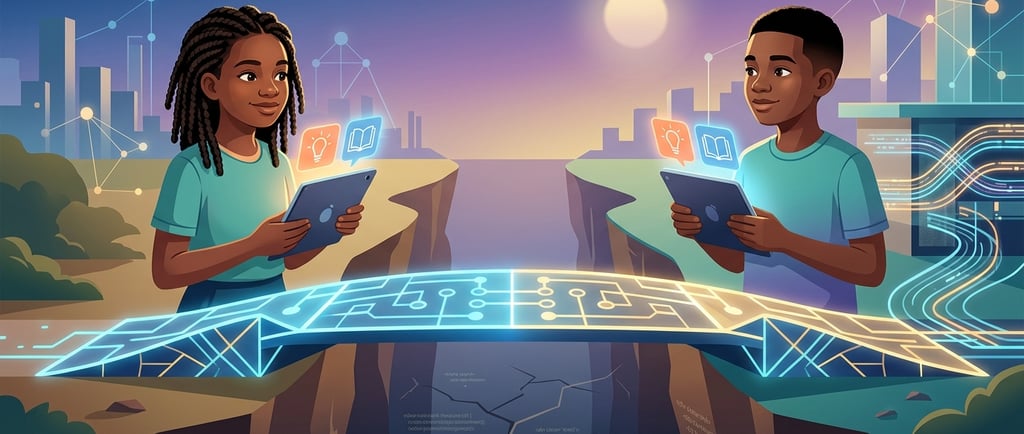
In the world of education, we often talk about the "digital divide." For years, this meant some students had fast internet and shiny laptops at home, while others did not. But in 2026, the divide has changed. It is no longer just about having a screen; it is about who can access the power of Artificial Intelligence.
As schools move toward AI-dependent curriculums—where AI acts as a personal tutor, an essay coach, and a research assistant—we are hitting a new kind of wall. If a student can only use these tools while sitting in a classroom, but their "AI tutor" disappears the moment they go home to a house without Wi-Fi, they aren't just falling behind. They are being locked out of the future.
For education leaders, the mission has shifted. We aren't just buying tablets anymore; we are searching for AI accessibility and offline solutions to ensure every student, regardless of their zip code, has a seat at the table.
The New Gap: "AI Haves" vs. "AI Have-Nots"
Imagine two 8th graders, Sam and Maya.
Sam has high-speed internet and a premium AI subscription at home. When he struggles with a math problem at 8:00 PM, he asks his AI tutor to explain it in a different way. The AI responds instantly, creating a custom practice quiz just for him.
Maya lives in a home where data is limited, or the connection is spotty. When she gets stuck on the same math problem, she’s stuck. Her school-provided AI tool requires a constant cloud connection to work. Because she can’t "talk" to the AI at home, she misses out on that personalized help.
By the time they get to class the next day, Sam has mastered the concept. Maya is frustrated. Over a school year, this small daily difference becomes a massive gap in learning.
The Solution: Bringing AI "On Device"
The good news is that tech leaders are listening. One of the biggest trends for school leaders right now is Edge AI or Offline AI.
Instead of an AI that lives far away in a giant data center (the "Cloud"), developers are creating "Smaller Language Models" (SLMs). These are smart enough to help with schoolwork but small enough to live directly on a student’s laptop or tablet.
How it works: A student downloads the AI updates while at school.
The benefit: When they go home, the AI works perfectly—even if the student is in "Airplane Mode" or has no Wi-Fi.
The result: The "tutor" stays in the student’s backpack, not just in the classroom.
Designing for Everyone: AI Accessibility Tools
Equity isn't just about internet access; it’s about making sure the AI itself is easy for everyone to use. School leaders are now prioritizing tools that focus on Inclusive Design.
For example, a student with a visual impairment might need an AI that can "see" a printed worksheet and read it aloud. A student who is still learning English might need an AI that can translate a complex science lesson into their native language in real-time.
When we look for "AI accessibility," we are looking for tools that:
Work with voice: For students who struggle with typing or have physical disabilities.
Translate instantly: To support our English Language Learners (ELL).
Simplify language: To help students with reading disabilities understand high-level concepts.
The Roadmap for School Leaders
If you are a principal or a district leader, how do you make sure your AI plan is fair? Here are three steps to consider:
1. Audit Your "Home Access" Reality
Don't assume every kid has "good enough" internet. Send out a survey. If 20% of your students have weak connections, any AI tool you buy must have an offline mode.
2. Prioritize "Privacy-First" Offline Tools
Offline AI isn't just better for equity; it’s better for privacy. When data stays on the device and doesn't go to the cloud, it’s much easier to keep student information safe and follow laws like COPPA and FERPA.
3. Train for "AI Literacy," Not Just Tools
The most expensive AI in the world is useless if a student doesn't know how to ask it the right questions. We need to teach students Prompt Engineering—the art of talking to AI—so they can use these tools to solve problems, not just get quick answers.
Conclusion: Building the Bridge
The "Digital Divide" has always been a moving target. In the 90s, it was about the computer. In the 2010s, it was about the internet. In 2026, it is about intelligence.
As leaders, our job is to make sure AI doesn't become a luxury item. By choosing tools that work offline and focusing on accessibility, we can make sure that every student—like Sam and Maya—has the same opportunity to succeed.
Let’s build a bridge that everyone can cross.