
Beyond Google: 5 Simple AI "Prompts" to Help Parents Support (Not Do) Homework
Here is a guide you can share directly with your families to demystify AI, ensure data privacy, and turn "homework help" back into "learning."
EDUCATION
ParentEd AI Academy Staff
1/29/20262 min read
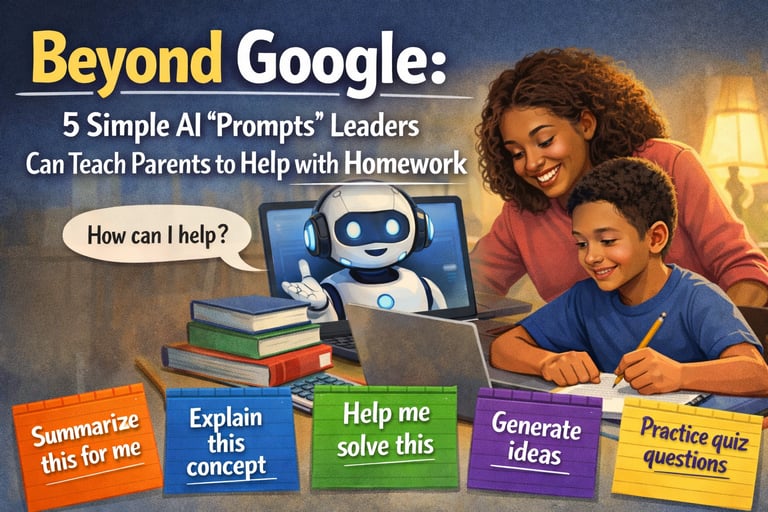
Beyond Google: 5 Simple AI "Prompts" to Help Parents Support (Not Do) Homework
As school leaders, we’ve all heard the same "whisper network" starting in the carpool lane: “Is everyone just using ChatGPT to write their essays now?” When parents feel a lack of clarity, they often default to one of two extremes: banning AI entirely or letting it run wild. Our job is to bridge that gap. We need to move the conversation from "How do we stop them from cheating?" to "How do we use this as the world’s most patient tutor?"
The secret lies in Prompt Engineering—a technical term for a very human skill: asking the right questions.
Here is a guide you can share directly with your families to demystify AI, ensure data privacy, and turn "homework help" back into "learning."
The Ground Rules: Integrity and Privacy
Before handing over the prompts, it is vital to give parents a clear "Rules of the Road" regarding safety:
The "No PII" Rule: Remind parents never to input Personally Identifiable Information (PII). This means no student names, birthdays, or specific school addresses.
The "Vetting" Policy: Reassure them that the tools used in school (like Khanmigo or your district’s specific AI portal) are FERPA-compliant and do not use student data to train models. Home tools (like the free version of ChatGPT) require more caution.
The "Tutor, Not a Ghostwriter" Mindset: Integrity isn't about the tool; it's about the output. If the AI writes the sentence, it's not the student's work. If the AI explains the logic behind the sentence, that's education.
5 Simple AI Prompts for Parents
These five prompts are designed to help parents guide their children through a struggle without simply handing them the answer.
1. The "Analogy" Prompt
The Prompt: "My child is struggling to understand [Topic]. They really love [Favorite Hobby]. Can you explain this concept using a [Favorite Hobby] analogy?"
Why it works: It bridges the gap between the abstract and the familiar.
Example: "Explain the water cycle using a Minecraft analogy."
2. The "Fifth Grader" Prompt (The Feynman Technique)
The Prompt: "Explain the core logic of [Complex Concept] to me like I’m in 5th grade. Use simple language and avoid jargon."
Why it works: It strips away the intimidating vocabulary so the student can grasp the "why" before they tackle the "how."
3. The "Scaffolded" Quiz Prompt
The Prompt: "Create a 5-question multiple-choice quiz about [Topic]. Don’t give me the answers yet. After I answer each one, tell me if I’m right and explain why."
Why it works: This turns a passive reading session into active retrieval practice. It’s perfect for test prep.
4. The "Check My Logic" Prompt
The Prompt: "I am doing a math problem: [Insert Problem]. Here are my steps: [Insert Student's Steps]. Don’t give me the answer, but tell me which step I made a mistake on and why."
Why it works: This is the ultimate "integrity" prompt. It forces the student to do the work while providing the immediate feedback a teacher would give in the classroom.
5. The "Socratic Tutor" Prompt
The Prompt: "I want you to act as a Socratic tutor. My child is trying to learn [Topic]. Ask them one question at a time to lead them to the answer themselves. Do not give them the solution."
Why it works: It prevents the "copy-paste" temptation by keeping the student in the driver's seat of the conversation.