
Beyond the Chatbot: How to Build a School for the AI Age
If you’ve been searching for things like “AI schools model USA” or “future classroom design,” you aren’t alone. We are moving away from "AI in the classroom" and toward "AI-centered school design."
EDUCATION
ParentEd AI Academy Staff
4/30/20263 min read
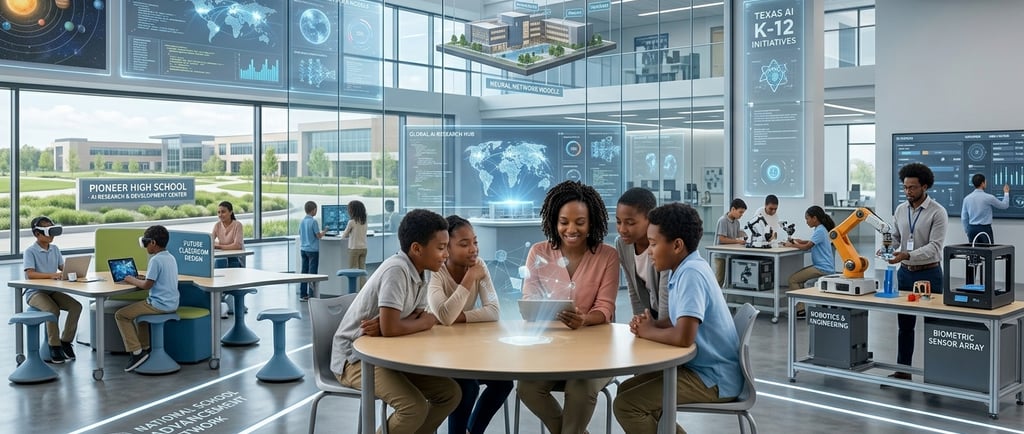
Have you ever felt like you are trying to build a plane while it’s already in the air? That is exactly what leading a school feels like right now. For the last two years, we’ve talked about AI like it was a fancy new calculator. But as we move through 2026, it’s clear that AI isn't just a tool—it's becoming the "operating system" for how our schools actually run.
If you’ve been searching for things like “AI schools model USA” or “future classroom design,” you aren’t alone. We are moving away from "AI in the classroom" and toward "AI-centered school design."
Here is what that looks like in plain English, without the tech jargon.
1. The "Smart" School Building: It’s Not Just About iPads
In the past, a "tech-forward" classroom just meant every student had a laptop. In a whole-school AI model, the building itself works differently.
Imagine a school where the schedule changes based on how students are feeling or how much progress they’ve made. Instead of a rigid 45-minute bell schedule, AI-native schools use "flexible pods." If a group of students is struggling with a math concept, the system can automatically adjust the afternoon schedule to give them more time with a human teacher, while other students move on to independent projects.
2. Moving from "Grading" to "Guiding"
One of the biggest shifts is how teachers spend their time. Right now, many teachers spend hours at night grading papers or writing reports. In an AI-transformed system, AI handles the "procedural" work—things like checking for basic understanding or drafting the first version of an Individualized Education Program (IEP).
This allows the teacher to step into a new role: The Lead Mentor.
Old Way: Teacher spends 60 minutes lecturing.
New Way: AI provides the basic facts at each student's pace, and the teacher spends 60 minutes leading a high-level debate or helping a student through a difficult emotional challenge.
3. Real-World Example: The "AI-Native" Expansion
We are seeing districts like Dallas Independent School District and Ector County ISD in Texas lead the way. They didn't just give out software; they spent a full year training their principals and school boards first.
At places like Arizona State University, they launched an "AI Innovation Challenge" where they tested over 200 different projects. One standout was a chatbot named "Sam" that lets students practice difficult conversations—like a doctor talking to a patient—before they ever try it in the real world. This is what we call "low-stakes practice," and it’s a game-changer for student confidence.
4. The Three Big "Pillars" of Transformation
If you are a leader looking to redesign your system, focus on these three areas:
A. AI Literacy as a Graduation Requirement
By 2026, knowing how to "talk" to an AI (prompting) and understanding its ethics is as important as reading or writing. States like California and Maryland are already passing laws to make sure students understand how their data is used and how to spot "deepfakes."
B. Equity and the "AI Divide"
The biggest fear for school leaders is that some kids will have "Premium AI" at home while others have nothing. A whole-school model ensures that every student has access to a high-quality, safe AI tutor regardless of their zip code.
C. Human-Centered Design
UNESCO and the OECD both released major reports this year reminding us of one thing: AI should never replace the human connection. The goal of a "Future Classroom" is actually to make school more human by taking away the boring, repetitive tasks so we can focus on creativity and community.
5. Where Do You Start?
You don't have to change everything on Monday. Most successful schools are following a "Pilot and Pivot" strategy:
Pick one problem: Is it teacher burnout? Student attendance?
Test one tool: Use a tool specifically built for schools (like MagicSchool or Khanmigo) rather than a general public chatbot.
Listen to the "Triple Veto": Get your IT, Legal, and Academic teams in one room. Don't let them work in silos, or the transformation will stall before it starts.
The future of the classroom isn't a robot standing at the front of the room. It’s a classroom where the technology is so smart that it stays in the background, allowing the teachers and students to do what they do best: Connect, create, and grow.
Sources & Further Reading:
How AI is Transforming Classrooms in 2026 (OTOS)
OECD Digital Education Outlook 2026
AASA: The Leadership Imperative for AI
UNESCO AI Competency Frameworks
GovTech: 5 AI Moves for School Leaders