
Brain Drain or Brain Gain? What AI is Really Doing to Our Kids’ Thinking Skills
Is AI actually “rotting” our kids' brains, or is it just a new tool we haven't learned to use yet? Let’s dive into what is really happening and how you can protect your child’s most important asset: their mind.
PARENTING
ParentEd AI Academy Staff
4/8/20265 min read
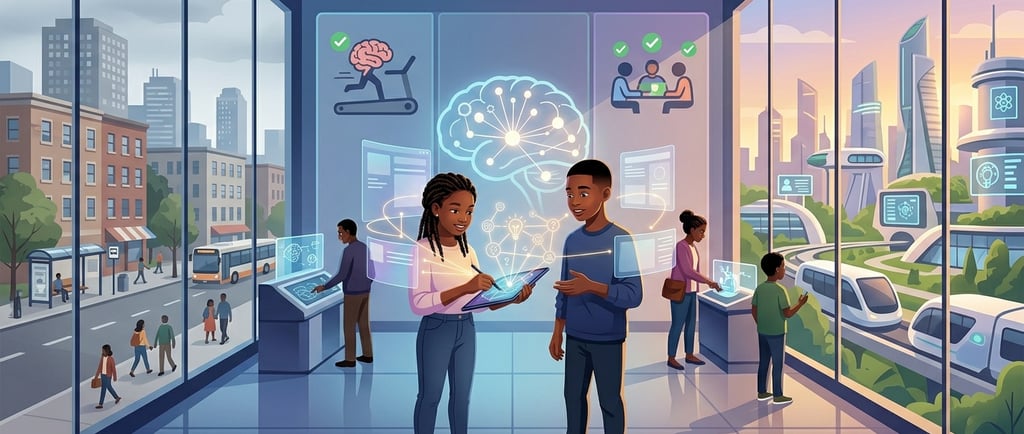
As parents, we have all seen it. Your child is staring at a screen, their fingers flying across the keyboard, or perhaps they are just speaking into their phone. They are “doing homework,” but a quick glance over their shoulder reveals they aren’t reading a textbook—they are chatting with an AI.
It feels like magic. In seconds, the AI summarizes a chapter of To Kill a Mockingbird or solves a complex long-division problem. But as an education technology leadership blogger, I’ve been hearing a growing chorus of alarm bells from the front lines of the classroom.
Just this month, global headlines have been dominated by a startling report: Two-thirds of secondary school teachers say students are losing their ability to think critically, be creative, and even hold a basic conversation because of AI overuse.
Is AI actually “rotting” our kids' brains, or is it just a new tool we haven't learned to use yet? Let’s dive into what is really happening and how you can protect your child’s most important asset: their mind.
The "Cognitive Offloading" Trap
Scientists use a fancy term called "cognitive offloading." In simple terms, it means letting a machine do the mental heavy lifting so our brains don’t have to.
Think of your brain like a muscle. If you go to the gym but let a robot lift all the weights for you, your muscles won't grow. Learning works the same way. When a student grapples with a difficult essay or a math puzzle, their brain is forming new neural pathways. It’s hard work, but that "struggle" is exactly where the learning happens.
Recent studies in 2026 have found a significant negative link between frequent AI use and critical thinking scores. Why? Because when AI provides the "final answer" instantly, it skips the "process." Students are moving from being "creators" of knowledge to "passive consumers" of it.
Teachers report that students no longer feel the need to learn how to spell or structure a sentence because they assume the AI will "fix it later." The result is that when the AI is gone, the student is left without the "mental tools" to solve problems on their own. This creates a fragile kind of intelligence that only exists when a device is powered on.
The "Effort-Reward" Cycle: Why Struggling is Good
There is a psychological reason why "easy" isn't always "better." Our brains have a built-in reward system. When we work hard to overcome a challenge, our brain releases dopamine—the "feel-good" chemical. This reinforces our motivation to keep learning. It is the same feeling a child gets when they finally finish a difficult Lego set or master a new level in a video game.
Many AI tools sidestep this process. By offering immediate solutions, they remove the intellectual challenge. This doesn't just hurt grades; it can hurt a child’s confidence. If a child never learns that they can solve a hard problem through their own effort, they become emotionally dependent on the machine to tell them what is right. They stop trusting their own gut and start trusting the algorithm.
"Students are losing core skills – thinking, creativity, writing, even how to have a conversation," one teacher noted in a recent National Education Union poll.
When a student relies on AI to generate ideas, they aren't practicing the "divergent thinking" that leads to true innovation. They are simply learning to curate what a machine suggests. This leads to a "sameness" in student work that worries many educators today.
Communication Breakdown: The Social Cost
It isn't just about math and history. Teachers are noticing a decline in communication and collaboration. When students use AI to "polish" their thoughts before they even speak them, they lose the ability to be authentic.
Real-world communication is messy, spontaneous, and requires empathy. AI, while smart, doesn't "feel" or understand social cues. If kids spend more time "prompting" a bot than debating with a classmate, their "social muscles" start to weaken. We are seeing students who can write a perfect AI-assisted email but struggle to look a teacher in the eye and explain their reasoning during a class discussion.
The "Bright Side": AI as a Power-Up, Not a Crutch
I don’t want to sound like a "tech-hater." AI isn't going anywhere, and it can be an incredible force for good if used correctly. The key is moving from Cognitive Offloading (letting the AI do the work) to Cognitive Augmentation (using AI to do better work).
Instead of asking an AI to "write an essay about the Civil War," which is a classic "bad use," we should encourage kids to ask the AI for three different viewpoints on the war so they can research them personally. Instead of asking for the answer to a math problem, they should ask the AI to explain the steps to solve it without giving the final answer.
Another great way to use AI is as a study buddy. Rather than letting it summarize a book so they don't have to read it, students can ask the AI to quiz them on the chapter they just read to see if they actually understood it. This keeps the child in the "driver's seat" of their own learning.
Practical Tips for Parents: How to Protect Your Child’s Brain
You don't need to be a tech expert to help your child navigate this. Here is a simple roadmap to keep their critical thinking skills sharp:
1. Enforce "Process First" Rules Make a rule that AI can only be used after the first draft is done. Let them struggle with the "blank page" first. The hardest part of thinking is the beginning—don't let the AI steal that from them. Once they have their own thoughts down, then they can use AI to look for counter-arguments or check their grammar.
2. Ask the "Why" and the "How" When your child shows you a finished project, ask them, "Why did you choose this argument?" or "How did you get to this conclusion?" If they can’t explain it without looking at the screen, they haven't learned it. Turn it into a game—ask them to "teach" you the topic for five minutes.
3. Encourage "Boredom" and "Offline Play" Creativity often happens when we are bored and our minds wander. In 2026, we are so connected that children rarely have a quiet moment to just think. Ensure your child has tech-free time to draw, build, or talk. These are the moments when the brain "integrates" what it has learned throughout the day.
4. Model Good AI Behavior If you use AI for work, show your child how you use it. Explain that you use it to organize your notes, but that you are the one making the final decisions. This shows them that the human is always the boss of the machine.
The Bottom Line
AI is the most powerful calculator ever invented, but it is not a replacement for a human mind. As we head further into 2026, our goal shouldn't be to raise kids who are merely good at "using AI"—it should be to raise kids who are smarter than the AI. By focusing on the "struggle" of learning and treating AI as a teammate rather than a replacement, we ensure that our children’s brains stay sharp, creative, and ready for a future that will require more critical thinking than ever before. Let's keep those mental muscles growing.