
Is AI Doing Your Child's Homework?
A new conversation is gaining momentum: AI agents. These are more advanced AI tools that don't just answer questions. They can complete tasks, follow instructions, and work through multiple steps with little human input.
PARENTING
ParentEd AI Academy Staff
6/19/20262 min read

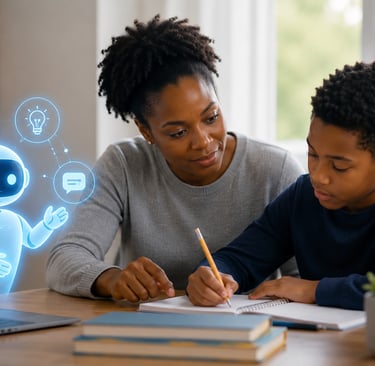
If you're a parent, you've probably heard about ChatGPT and other AI tools.
But this week, a new conversation is gaining momentum: AI agents.
These are more advanced AI tools that don't just answer questions. They can complete tasks, follow instructions, and work through multiple steps with little human input.
For parents, this raises an important question:
How do we know when AI is helping our children learn—and when it's doing the learning for them?
What Are AI Agents?
Think of a regular AI chatbot as a calculator.
You ask it something, and it gives you an answer.
An AI agent is more like a personal assistant.
A student could ask it to:
Research a topic
Create an essay outline
Draft the essay
Generate a presentation
Prepare speaking notes
All in a single request.
The technology is improving rapidly, and many experts believe AI agents will become common tools in schools, universities, and workplaces.
The Good News
AI can be incredibly helpful for learning.
Students can use AI to:
Understand difficult concepts
Get help with homework
Practice writing
Brainstorm ideas
Receive instant feedback
For children who struggle with confidence or need extra support, AI can provide personalised assistance at any time of day.
Used well, AI can make learning more accessible and engaging.
The Challenge for Parents
The concern isn't that children use AI. The concern is whether they are still doing the thinking.
If AI writes the essay, solves every problem, or completes an entire project, children may miss opportunities to develop critical skills such as:
Problem-solving
Creativity
Communication
Independent thinking
These skills remain essential, regardless of how advanced technology becomes.
Questions Parents Should Ask
You don't need to become an AI expert.
Instead, try asking simple questions when your child uses AI:
What did the AI help you with?
What parts did you do yourself?
Do you agree with the answer it gave?
Could you explain this topic without AI?
These conversations encourage children to think critically about the information they receive.
Preparing Children for an AI Future
The reality is that today's students will enter workplaces where AI is part of everyday life. The goal isn't to avoid AI.
The goal is to help children use it responsibly. Experts increasingly suggest that digital literacy now includes AI literacy—the ability to understand how AI works, recognise its limitations, and use it thoughtfully.
Parents can support this by encouraging children to:
Verify information from multiple sources
Think critically about AI-generated content
Use AI as a helper, not a replacement
Be transparent when AI has been used
AI agents are likely to become a normal part of education and work. The most important question isn't whether children will use AI. It's whether they are still learning while they use it.
When AI supports curiosity, understanding, and creativity, it can be a powerful educational tool.
When it replaces thinking, the benefits quickly disappear. The future belongs to children who know how to work with AI—not depend on it.
Sources
Stanford Institute for Human-Centered AI, "AI Challenges Core Assumptions in Education" (2026)
Stanford Accelerator for Learning, AI+Education Summit findings (2026)
Axios, "AI's education explosion leaves teachers in the dark" (2026)
Educators Technology, "Agentic AI in Education: What Teachers Need to Know in 2026"
World Economic Forum, research on AI literacy and future workforce skills