
"My Child's Job Doesn't Exist Yet": How to Help Parents Use AI to Build Future-Ready Skills
The future of work is here, and it's being powered by AI. As educators, how do we help parents prepare their children for jobs that are still being invented?
EDUCATION
ParentEd AI Academy Staff
11/25/20253 min read
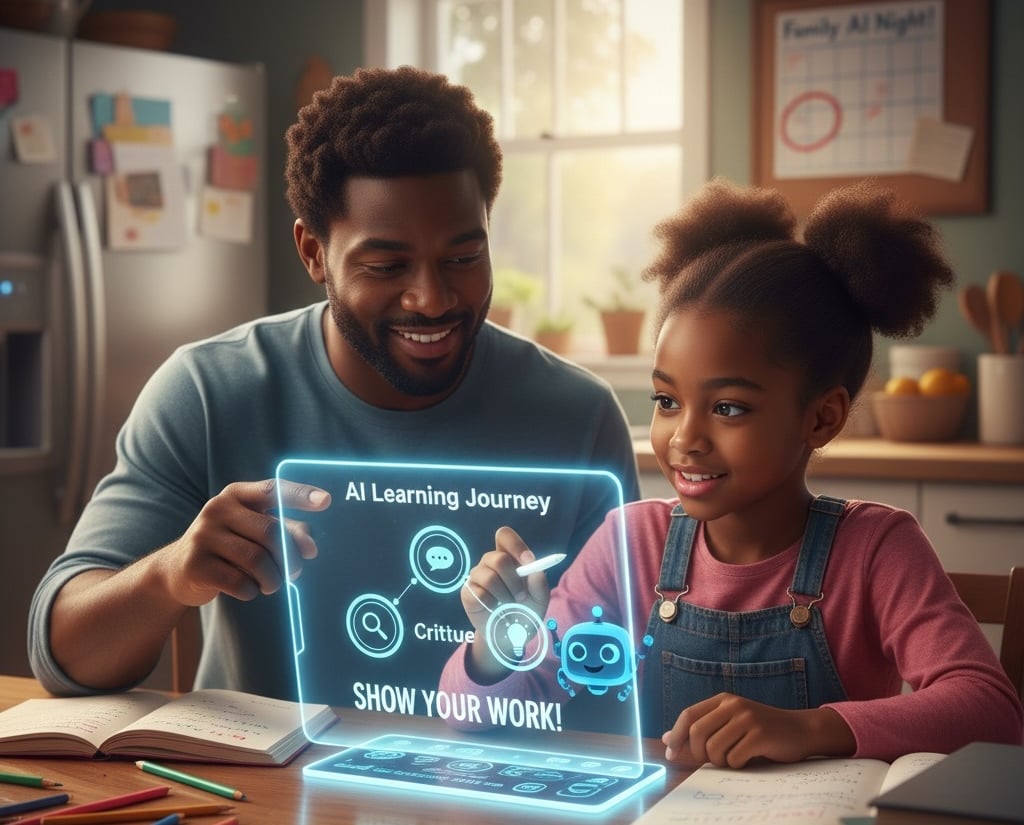
The question, "What do you want to be when you grow up?" is now met with a profound truth: many of today's students will enter careers that haven't been invented yet. The rapid advancement of Artificial Intelligence (AI) has ushered in an era of uncertainty, and for parents, the anxiety is understandable.
As school leaders, our role is to acknowledge this fear and immediately pivot the conversation. AI is not a problem to be solved, but a powerful, double-edged tool that requires mastery. Our core mission is to guide parents to see AI not as a threat, but as a dynamic catalyst for building the adaptability, critical thinking, and ethical judgment that will be indispensable in a future workforce defined by technological collaboration.
Shifting the Focus: From Anxiety to Augmentation
The first step in partnering with parents is demonstrating AI's immense potential. We are moving away from teaching students to recall information—a task AI performs instantly—and toward fostering skills that truly augment human capability.
When used thoughtfully, AI acts as a sophisticated assistant:
Personalized Tutoring: AI-powered tools provide immediate, tailored feedback and practice problems, acting like a patient, 24/7 tutor that adapts precisely to how a child learns best.
Efficiency for Deeper Work: By handling rote tasks (like summarization or first drafts), AI frees up student time. This is not about cutting corners; it’s about allowing students to dedicate their energy to the highest-level critical work: analysis, creation, and deep reflection.
We encourage parents to view AI as a "Co-Pilot" for learning, not a replacement. The goal is to maximize the time their children spend on skills that machines cannot automate.
The New Future-Ready Curriculum: Mastering the Human Element
The fear that "robots will take the jobs" is incomplete. Instead of replacing people, AI is elevating the stakes for distinctly human skills (McKinsey, 2025). The most valuable lessons we teach families involve navigating the uncertainty of change itself.
1. Cultivating Adaptability and Resilience: The tools will change every few years, making continuous learning non-negotiable (Dweck, 2006). Parents can support this by modeling a growth mindset. When a new AI tool emerges, encourage the family to explore it together, openly acknowledging, "I don't know how this works yet, but let's figure it out."
2. Elevating Prompt Literacy (AI Fluency): The quality of AI output depends entirely on the quality of the human input—the prompt. This is a foundational skill in the digital economy. Encourage parents to practice this at home by challenging their child to rewrite the same prompt five times to get a better result. This strengthens their ability to articulate their intent clearly, a core communication skill required in every career.
Navigating the Double Edge: Setting Ethical Boundaries
To build future-ready skills, we must ensure students engage critically with the tools, not passively. We must help parents understand that the greatest risks are not technical, but ethical and cognitive.
The Threat to Thinking: Cognitive Over-Reliance
The most profound danger is the threat to independent thinking. If a student bypasses the challenging struggle of problem-solving or drafting, they sacrifice the friction that builds deep cognitive muscle.
School Leader Action: We must guide parents to enforce the "Show Your Work" rule for AI assignments. Students should be required to share the prompt they used, the AI’s initial output, and their own significant critical edits and reflections. This shifts the focus of the grade away from the output and onto the essential human analysis.
The Threat to Truth: Bias and Misinformation
AI is a confident liar. Since models are trained on imperfect internet data (Source: Common Sense Media), they are susceptible to systemic bias and factual errors (often called "hallucinations").
School Leader Action: We position AI literacy as the new media literacy. Parents must understand that every AI response must be treated as a hypothesis that requires verification from at least two credible, non-AI sources. This reinforces the need for human judgment and ethical reasoning. Encourage parents to ask: "How do you know that’s true, and whose perspective is missing from the AI’s answer?"
The Threat to Privacy: Data Security
Every interaction with a public AI tool involves submitting data. Schools must clearly communicate to parents that this information can be collected and used to train future models.
School Leader Action: Institute a strict rule that families should never input personal identifiers, private student records, or sensitive school data into public AI platforms. Use only school-vetted tools for sensitive academic work, making privacy an explicit part of digital citizenship.
A Partnership of Purpose
By treating AI as a complex reality, we move past the "cheating panic" and toward a "critical thinking" partnership. Our responsibility is to facilitate open conversations, establish clear ethical guardrails, and focus on those uniquely human skills. This collective clarity empowers families to transform uncertainty into a powerful force, ensuring our students are not just ready for the future, but ready to lead it.
Sources Referenced: