
The "Autopilot" Era: How Smart AI is Changing Your School in 2026
From Chatbots to Co-Pilots: Why 2026 is the Year Your School Goes on "Autopilot"
EDUCATION
ParentEd AI Editorial Tem
3/21/20263 min read
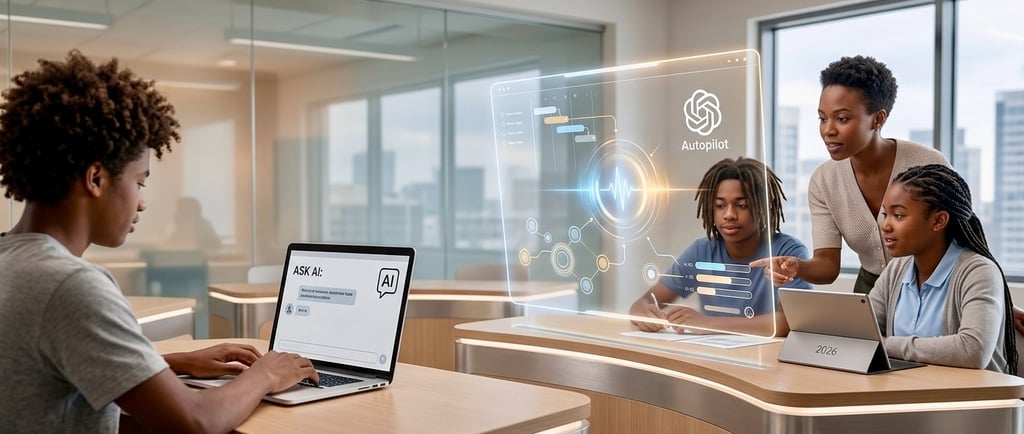

If you walked into a classroom today, you might see students using AI to help them brainstorm ideas for an essay. But by 2026, the technology has changed from a simple helper into something much more powerful. We call this new phase "Agentic AI."
For school principals, teachers, and parents, this isn't just a new app—it’s a total shift in how schools work. It is the difference between using a GPS to find your way and sitting in a car that can actually drive itself. In 2026, we are moving from "GPS navigation" to true "Autopilot."
What is "Agentic AI"?
To understand this, we have to look at how AI has grown.
Old AI (The Helper): Think of this like a smart calculator. You ask it a question, and it gives you an answer. It waits for you to tell it exactly what to do.
Agentic AI (The Co-Pilot): This version is much smarter. It doesn't just wait for a command; it can set its own goals. If a student is struggling with math, the AI "Agent" can see the problem, create a step-by-step plan to help them, and adjust that plan as the student learns. It acts like an invisible assistant that stays with the student all day.
The Big Gap: Students are Leading the Way
The numbers show that this change is happening fast. Almost every student is using some kind of AI now. In fact, 92% of college students use these tools every single day.
However, there is a problem. About 80% of students feel that their schools are moving too slowly. While students are using AI at home to learn and explore, many schools are still trying to figure out how to use it in the classroom. This puts a lot of pressure on school leaders to stop thinking of AI as just a "toy" and start seeing it as a necessary part of the school building.
Saving Time for the "Human Touch"
One of the biggest wins for Agentic AI is helping our teachers. We know that teachers are often overworked and tired.
Data shows that teachers who use AI agents save about six hours every week. If you add that up over a whole school year, it’s like giving a teacher six weeks of their life back. * The Busy Work: AI agents handle things like taking attendance, grading simple assignments, and organizing lesson plans.
The Mentoring: Because the AI handles the "paperwork," teachers have more time to be mentors. They can sit down one-on-one with students who are struggling or frustrated. The AI doesn't replace the teacher; it clears the teacher's schedule so they can focus on being human.
The "Struggle" of Learning: A Note for Parents
Many parents are asking a great question: “If the AI does the work, will my child still learn how to think?”
This is what experts call "Productive Friction." Think of it like exercise. If a machine lifts the weights for you, you don't get any stronger. Learning is the same way. If an AI writes the whole essay, the student doesn't learn how to organize their thoughts.
Parents and teachers are worried that if we make learning "too easy," students might lose their ability to solve hard problems on their own. This is why schools in 2026 are focusing on using AI to help with the "boring" parts of research, while making sure the "thinking" parts stay in the student's brain.
Staying Safe: Privacy and "Computer Tracking"
Another big topic is privacy. Since these AI agents "follow" a student's progress, they collect a lot of data. Some parents worry about "computer tracking"—the idea that an invisible AI is always watching to see if a student is paying attention or making mistakes.
To make this work, schools must have very strict rules. They need to be clear about:
Who sees the data? (Only the teacher and parents).
How long is it kept? (It shouldn't follow a student forever).
Is it fair? (Making sure the AI doesn't judge a student unfairly based on one bad day).
The Road Ahead: A "Yellow Light"
As we move further into 2026, the future of school looks bright, but we must be careful. Think of it like a Yellow Light—we should keep moving forward, but we need to keep our eyes on the road.
The benefits are huge: students get lessons tailored exactly to them, and teachers get more time to actually teach. But we can't let the technology take over completely. We must make sure that school is still a place for human connection, hard work, and big ideas.
The AI might be the "Autopilot," but the teachers and students are still the ones choosing where the plane is going.