
The K-5 Conversation: Talking to Parents of Younger Students About AI (Before They Panic)
As school leaders, our job isn't just to manage the tech—it’s to manage the narrative. Here is how to frame the AI conversation for your K-5 community before the panic sets in.
EDUCATION
ParentEd AI Academy Staff
2/20/20262 min read
If you mention "Artificial Intelligence" in a high school staff room, the conversation usually shifts immediately to academic integrity and the death of the five-paragraph essay. But mention it at a Kindergarten orientation or a 3rd-grade back-to-school night? You’ll likely see a very different reaction: pure, unadulterated panic.
For parents of younger children, AI feels less like a "cheating tool" and more like a mysterious digital frontier. They’re worried about screen time, data privacy, and whether their seven-year-old is about to be "replaced" by a robot before they’ve even mastered long division.
As school leaders, our job isn't just to manage the tech—it’s to manage the narrative. Here is how to frame the AI conversation for your K-5 community before the panic sets in.
1. Shift the Focus: From "Output" to "Inquiry"
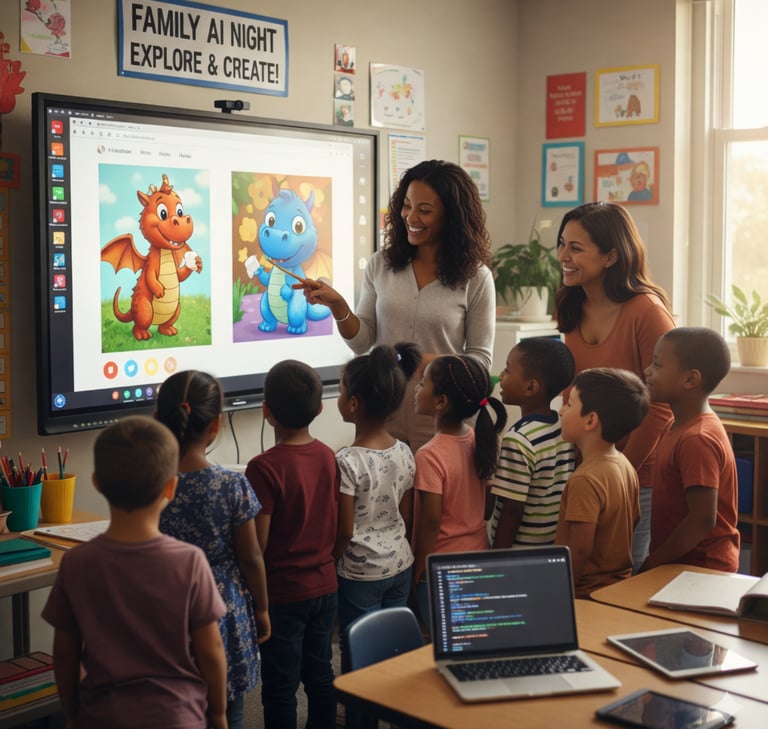
In high school, AI is often seen as a shortcut to a finished product. In elementary school, we need to show parents that AI is a spark for curiosity. Explain to parents that in a K-5 setting, AI isn't writing their child's book report; it’s helping them brainstorm what a "dragon who loves marshmallows" might look like. It’s about:
Creativity Tools: Using AI-powered drawing apps to bring stories to life.
Adaptive Learning: Software that meets a student exactly where they are in reading or math.
Critical Questioning: Teaching kids that the "magic box" isn't always right, which builds healthy skepticism early.
2. Address the "Privacy Elephant" in the Room
Parents of young children are rightfully protective of their kids' digital footprints. Transparency is your best friend here. When speaking to parents, be ready to answer:
What tools are we using? (Highlight only vetted, COPPA/FERPA compliant platforms).
Who sees the data? (Reassure them that child data isn't being fed into public training sets).
The "Human-in-the-Loop" Policy: Remind them that AI in your school is a co-pilot for the teacher, not a replacement for the educator's heartbeat and intuition.
3. Focus on "Foundational Literacy"
A common fear is that AI will make kids "lazy." We can counter this by emphasizing that AI requires more literacy, not less. To use AI effectively, even at a basic level, a student needs:
Strong Vocabulary: You can’t write an effective prompt if you don't have the words to describe your vision.
Logical Sequencing: Understanding how to give instructions is a core coding and life skill.
Fact-Checking: We are teaching students to be "Editors-in-Chief" of the information they receive.
The Bottom Line: Be the Calm Voice
The goal of your first communication shouldn't be to explain the architecture of a Large Language Model. It should be to reassure parents that the core mission of school hasn't changed. We are still teaching kids how to think, how to be kind, and how to solve problems. AI is simply a new set of crayons in the box—different and powerful, but still requiring a human hand to create something meaningful.
Pro-Tip for Leaders: Host a "Family AI Night" where parents and kids use a controlled AI image generator together to create a class mascot. When they see the tech in action as a collaborative tool, the "scary" factor vanishes.