
The Principal's Playbook: Hosting a High-Impact "Parent AI Night"
A Step-by-Step Guide for School Leaders
EDUCATION
ParentEd AI Academy Staff
12/11/20254 min read
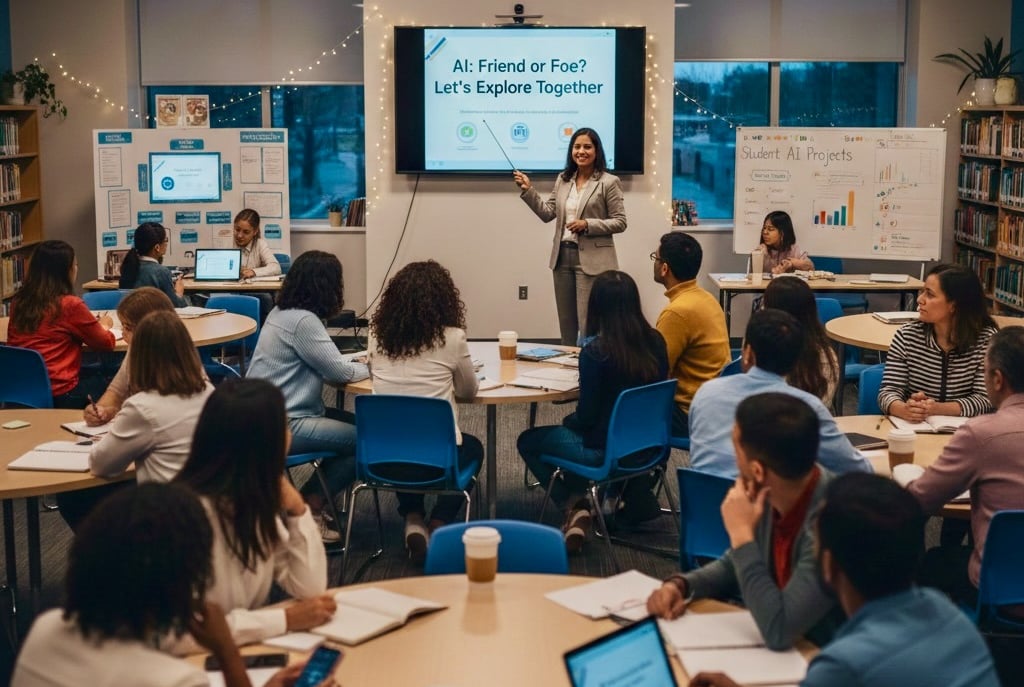
The quiet hum of the modern classroom is rapidly being overlaid by a new sound: the whirring complexity of Artificial Intelligence. For school leaders, the conversation about AI is no longer a matter of if, but how and when we will lead it. Our parents are caught between the breathtaking promises of AI and a genuine, often acute, anxiety about its impact on their children's integrity, future careers, and well-being.
Ignoring this tension is a path to misinformation and mistrust. Embracing it is an opportunity to position your school as a thoughtful, proactive leader in the digital age.
That’s why we are sharing this Principal's Playbook: a high-impact, step-by-step strategy for hosting a "Parent AI Night" that doesn't just present facts, but calms fears, builds community trust, and transforms parent apprehension into informed partnership. From setting the right tone to structuring the conversation around ethical use and practical home strategies, this plan provides the roadmap to ensure every family leaves empowered, ready to navigate the AI-driven world alongside you.
Phase 0: Pre-Launch & Planning (4-6 Weeks Out)
This initial phase is critical for success, focusing on building your team and defining your message.
1. Form the Core AI Team
Responsible: The Principal.
Team Composition: Include 1-2 Tech Teachers, 1 Counselor or Librarian (for digital literacy/ethics), and 1 Parent Liaison (for communication insight).
2. Determine Focus & Tone
Tone: Curious, Reassuring, and Empowering. Avoid: Alarmist or overly technical language.
Core Focus Areas: Ethical Use, Critical Thinking, and Future Workforce Skills.
3. Secure Your Resources
Guest Expert (Optional): Consider inviting a local university professor, a K-12 EdTech director, or a leader specializing in AI ethics to add external credibility.
Define Your 3 Key Takeaways: Every presentation needs a clear anchor. Example Takeaways: 1. AI is a powerful tool, not an automatic cheat. 2. Our school teaches ethical use. 3. Parents can use AI to support learning at home.
Phase 1: The Communications Strategy (3 Weeks Out)
Your messaging must address the underlying fear to encourage attendance and engagement.
3 Weeks Out (Soft Launch Hook): Use a compelling, relatable question in your newsletter or social media: "Is AI making your student a better learner or a better cheater? Join us to find out."
2 Weeks Out (Formal Invitation): Send a direct email with a professional title and clear RSVP: "AI Demystified: A Practical Guide for Parents on Cheating, Careers, and Critical Thinking."
Community Survey: Distribute a quick survey (e.g., Google Form) asking parents: "What is your #1 fear about AI in education?" Use the top three responses to structure your presentation's Q&A section.
1 Day Before (Final Reminder): Use a text alert or school app notification: "Your Questions Answered. (Reference top survey fears.) See you tomorrow!"
Phase 2: The 90-Minute Playbook: Event Structure
This structured flow guides the audience from apprehension toward action.
A. Building Trust (0:00–0:30)
Welcome & Acknowledging the Fear (0:00–0:15) – Led by the Principal: Build trust by acknowledging parental concerns immediately. Frame AI as a powerful tool that requires ethical teaching and guidance, not simply a threat.
AI 101: From Abstract to Appliance (0:15–0:30) – Led by Tech Lead/Expert: Demystify AI. Showcase 3 everyday AI examples (streaming recommendations, GPS, predictive text) to make it relatable. Explain AI's current limitations—it generates predictions, not absolute truth.
B. Calibrating Policy & Integrity (0:30–0:45)
The School's Stance: Integrity & Ethics (0:30–0:45) – Led by Curriculum Lead: Detail your updated Academic Integrity Policy. Explain how assignments are changing to focus on uniquely human skills like reflection, personal opinion, and critical analysis, making them less susceptible to AI over-reliance.
C. Inspiring Action (0:45–1:30)
Student Showcase: AI as a Thought Partner (0:45–1:05) – Led by Students & Supervising Teacher: This is your most powerful segment. Have 2-3 students demonstrate responsible use: using AI to refine coding, outline an essay structure, or generate study prompts. Crucial: Emphasize the necessary human vetting, editing, and critical thinking required.
Parent Playbook: 3 Actions for Home (1:05–1:15) – Led by Counselor/Librarian: Distribute and review the one-page handout of actionable tips for home use (See Phase 3).
Q&A/Open Dialogue (1:15–1:30) – Led by Core Team: Prioritize addressing the top fears identified in the pre-event survey. Keep answers concise and community-focused.
Phase 3: Actionable Resources & Takeaways
The content parents leave with reinforces the evening's message.
Parent Handout: AI Home Guide
Rule #1: The AI Test. Before submitting any AI-assisted work, ask your child: "Could you have achieved the same level of depth without the tool?" If the answer is genuinely "No," they've used it effectively as a thought partner. If the answer is "Yes," they've likely over-relied on it.
The Critical Consumer: Every time AI provides information, tell your child to search for the same topic on Google or check an authoritative source. This teaches them to check for AI Hallucinations (false information).
Family Challenge: Use an AI tool (like an image generator or a language model) together to collaborate on a fun, non-academic project. This models collaborative and responsible use.
Phase 4: Follow-Up & Assessment
Reinforce the message and measure the event's impact.
Thank You & Resources Email: (Within 24 hours): Include a link to a recording (if applicable), attach the Parent AI Home Guide handout, and link to your school's updated Academic Integrity Policy.
Assessment Survey: Send a quick 2-question survey: 1) Did this event make you feel more or less anxious about AI? 2) What is the one action you plan to take at home to support your child's learning with AI?
Internal Debrief: Review feedback with the Core AI Team and plan a follow-up, more advanced session (e.g., "AI and College Applications") for the next semester.
From Playbook to Partnership
The success of your "Parent AI Night" won't be measured by attendance numbers, but by the quality of the conversations that follow. By executing the steps within this playbook—by acknowledging parent fears head-on, showcasing concrete student use cases, and providing actionable home strategies—you achieve more than just an event; you forge a crucial partnership.
This initiative positions your school not merely as an adopter of new technology, but as the ethical guide for your community. You have transformed a potentially divisive issue into a shared learning experience, ensuring that parents, students, and educators are all speaking the same language about the responsible, critical, and powerful role AI will play in the 21st century.
Use the follow-up strategies outlined in Phase 4 to maintain this momentum. The conversation about AI is continuous, but thanks to your proactive leadership, your community is now prepared, aligned, and ready to learn together.