
Why "Human-in-the-Loop" is the Secret to AI in Schools
For school leaders and educators, the initial "shock" of AI has worn off, and we are now left with a much bigger question: How do we teach students to use it without losing their ability to think for themselves?
EDUCATION
ParentEd AI Editorial Team
4/2/20264 min read
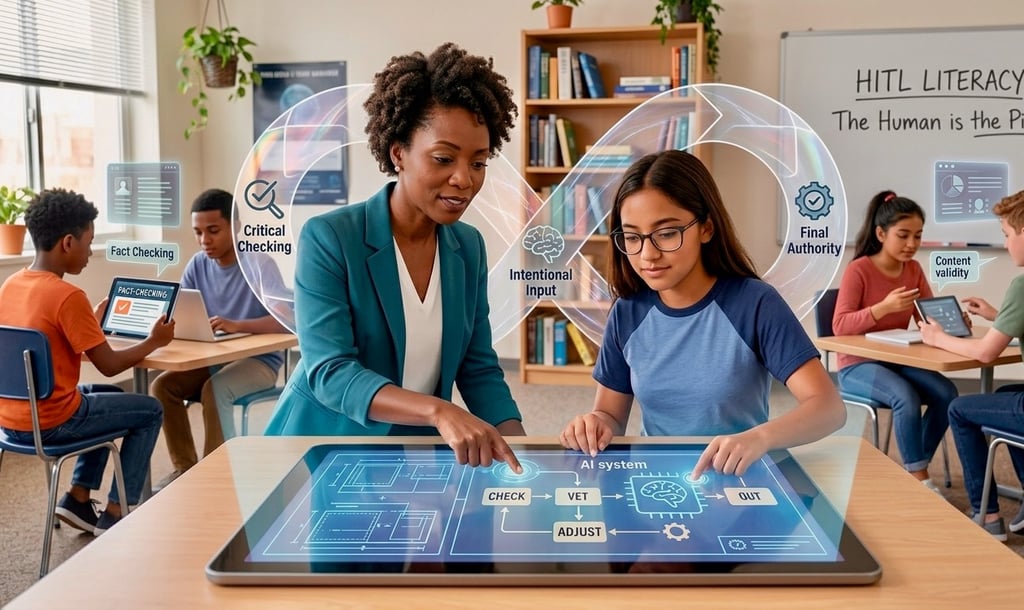
Artificial Intelligence (AI) is no longer a futuristic idea; it is sitting in the backpacks and on the laptops of almost every student in your building. For school leaders and educators, the initial "shock" of AI has worn off, and we are now left with a much bigger question: How do we teach students to use it without losing their ability to think for themselves?
The answer lies in a concept called Human-in-the-Loop (HITL) Literacy. While it sounds like a technical term, it’s actually very simple. It means that while AI can do a lot of the "heavy lifting," a human must always be at the center of the process—checking the work, making the final decisions, and providing the heart and soul. Here is why this is the most important skill we can teach this year.
What Exactly is Human-in-the-Loop?
Think of AI like a powerful bicycle. It can help you go faster and farther than you could on foot, but it won’t steer itself, and it certainly won’t tell you where you should go. If you take your hands off the handlebars, you’re going to crash.
In education, "Human-in-the-Loop" means that we don't just "outsource" our thinking to a machine. Instead, we use the machine to brainstorm, organize, or draft, while the human—the student or teacher—acts as the Editor-in-Chief.
The Three Pillars of HITL Literacy
Critical Checking: Knowing that AI "hallucinates" (makes things up) and being able to spot those errors.
Intentional Input: Learning how to give the AI clear, ethical, and smart instructions (prompts).
Final Authority: Understanding that the human is legally and morally responsible for whatever the AI produces.
For School Leaders: Moving Beyond the "Ban"
A year ago, many schools tried to ban AI. Today, we know that doesn’t work. The goal for leadership now is to move from policing to partnership. When we focus on "Human-in-the-Loop" literacy, we change the conversation. Instead of asking, "Did a robot write this?", we ask, "How did you use the tool to improve your original thought?"
School leaders should encourage teachers to:
Show the Work: Ask students to submit their AI prompts along with their final essays.
Audit the Output: Create assignments where the goal is to find the mistakes in an AI-generated paragraph.
Focus on Process over Product: Value the "messy middle" of learning rather than just the final 500-word paper.
For Teachers: Your New Role as a "Co-Pilot"
For many educators, there is a fear that AI will make their jobs obsolete. In reality, HITL literacy makes the teacher more important than ever. AI can generate a lesson plan in three seconds, but it doesn't know that "Sam" in the back row is struggling with grief, or that "Maya" learns better when she can draw her answers.
Human-in-the-Loop teaching means:
Using AI for the "Drudge Work": Let AI draft your initial emails to parents or help you brainstorm 10 ways to explain fractions.
The "Final 20%": Use the time you saved to add the "human touch"—the empathy, the local context, and the personal connections that a machine can't replicate.
The Parent Connection: Bridging the "Ethics Gap"
This is where things get tricky. Research shows there is often a "gap" between how students use AI and how parents think they are using it.
Parents are understandably worried. They see their kids using AI tutors or writing assistants and wonder if their child is actually learning anything. As educators, we need to bring parents into the loop.
What we should tell parents:
AI is a Tutor, Not a Ghostwriter: Encourage parents to ask their kids: "What did you learn from the AI today?" rather than "Did the AI finish your homework?"
The Transparency Talk: Schools and parents must agree that using AI is okay, as long as it is disclosed. When a student uses AI secretly, the "human" is no longer in the loop—they are just a delivery person for a machine.
Safety First: Parents need to know that AI models can sometimes give biased or inappropriate advice. HITL literacy at home means parents and kids looking at AI results together and discussing what looks right and what looks wrong.
Why This Matters for the Future
By the time today’s middle schoolers graduate, almost every job will involve some form of AI. The people who will succeed are not the ones who can press "generate" the fastest. The winners will be the ones who can critique, edit, and improve what the AI gives them.
If we teach our students to be "passengers"—just sitting back while the AI drives—we are failing them. But if we teach them to be the "pilots," we are giving them a superpower.
Final Thoughts for Educators
Human-in-the-loop literacy isn't a "tech" skill. It’s a thinking skill. It’s about curiosity, skepticism, and ownership. As we navigate this "Autopilot Era," let’s make sure our students never forget that they are the ones in charge of the machine—not the other way around.
Sources & Further Reading
U.S. Department of Education: Artificial Intelligence and the Future of Teaching and Learning (2023). This report emphasizes the need for "human-in-the-loop" systems to protect student data and ensure equity.
edmentum: AI Literacy in K-12: A Primer for Educators of AI.
World Economic Forum: The Future of Jobs Report (2025). Highlights why analytical thinking and AI literacy are the top skills for the modern workforce.